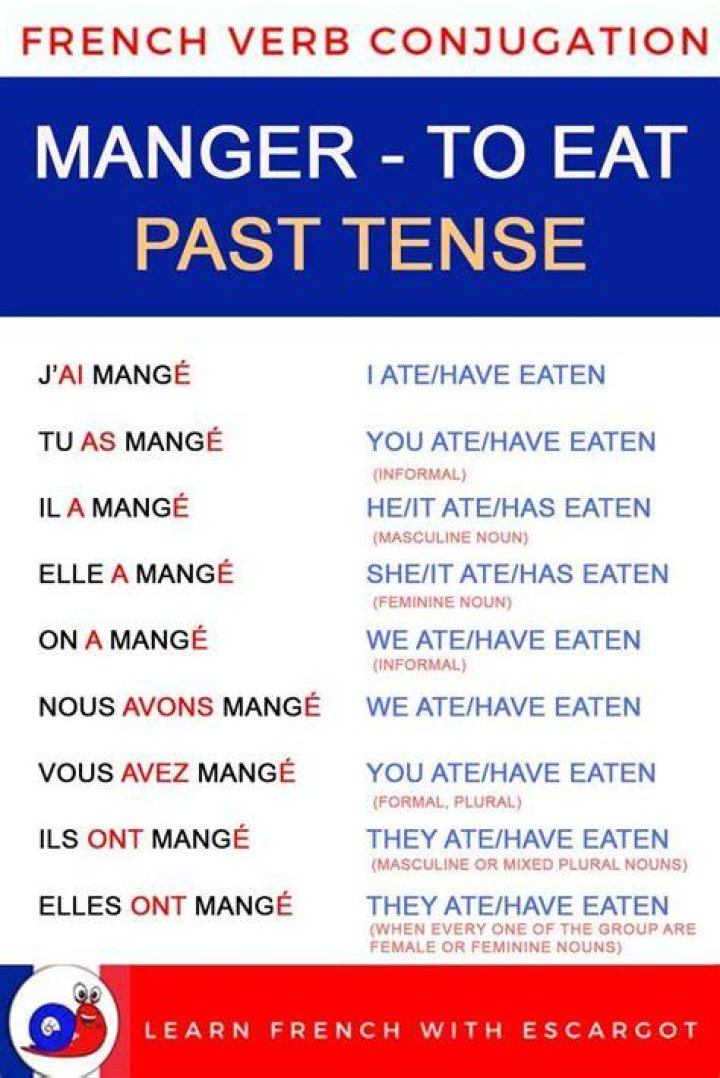
What tense is manger
 Chloe Ramirez
 jemangeil/ellemangenousmangeonsvousmangezils/ellesmangent
What are irregular verbs in French?
Irregular verbs are simply verbs that don’t follow the normal rules of conjugation. For example, regular verbs ending in -er all change their endings the same way when conjugated. Regular -ir and -re verbs follow their own sets of rules as well.
What is manger in the perfect tense?
j’aie mangétuaies mangéil/elleait mangénousayons mangévousayez mangé
Is manger etre or avoir?
In the above examples, manger, like most verbs, uses avoir. But tomber is a special verb that uses être instead.
How do you conjugate the verb manger in present tense?
- je mange. tu manges.
- il mangeait. nous avons mangé
- vous mangerez.
- ils mangeraient.
Is Aller irregular?
Aller is one of the most common French verbs – here’s how to conjugate it into every tense and mood. Aller is an irregular -er verb and needs the auxiliary verb être in compound tenses. Il va partout !
Is jouer an irregular verb?
The French verb jouer means “to play.” This is a very common regular -er verb and it is used so much that you’ll want to be able to use it properly.
Is Parler avoir or etre?
To form it for parler, you will use the auxiliary verb avoir along with the past participle parlé.
Is pouvoir irregular?
The French verb pouvoir means “to be able [to do something],” or more simply, “can” and “may.” It’s an extremely common verb in French and has an irregular conjugation that can be tricky for non-native speakers. For this conjugation, it’s best to learn it by heart.
Is Jeter an irregular verb?
Jeter is one of two verbs that means “to throw” in French, and conjugation of this common verb can be tricky for students to learn. But this stem-changing verb, like lancer (which means the same thing), is a very useful one to know.
Article first time published on
Is Voyager etre or avoir?
Voyager in the Compound Past Tense It can be easier than memorizing all those imperfect forms, though you will need the auxiliary verb avoir and the past participle voyagé. For this construction, you only need to conjugate avoir in the present tense to fit the subject pronoun.
Is Choisir an irregular verb?
Choisir, “to choose, pick, decide,” is conjugated as a regular French -ir verb. Regular verbs share conjugation patterns in person, number, tense and mood. Verbs with infinitives that end in -ir are the second largest category of regular French verbs, after French verbs ending in -er.
What is the German word for manager?
NounRelated TranslationsOther TranslationsmanagerGeschäftsführer; ManagerAbteilungsleiter; Abteilungsleiterin; Agent; Anführer; Direktor; Führer; Geschäftsführer; Geschäftsführerin; Impresario; Verwalter; Vorsitzender; leitender Verwaltungsangestellter
What is called manager?
A Manager is a person who manages or is in charge of something. Managers can control departments in companies, or guide the people who work for them. … According to Henri Fayol, a French management theorist, managers must be able to do: planning. organizing.
How do you say manager in different languages?
- Hungarianmenedzser.
- Korean경영자
- Castilian Spanishel encargado.
- Japaneseマネージャー
- Frenchle responsable.
- Mandarin Chinese经理
- Germander Manager.
- Russianменеджер
Is manger avoir or etre in passe compose?
PresentSubjunctiveilsont mangéaient mangéPassé simpleParticiplesje / j’mangeaitumangeas
Is Manger a regular verb?
Manger is a regular French -er verb, but it is also a spelling-change verb. This means that it takes all the regular -er endings, but a small spelling change is made to the stem for consistency of pronunciation. The stem: the infinitive manger minus the -er ending, which leaves the stem mang-.
What tense is je Jouerai?
VERB CONJUGATION TABLE jouerSimple Tenses jouerTENSEje/j’ilPresent Présent playjouejouePast Imperfect Imparfait playedjouaisjouait
What are some ER verbs?
- Aimer (to like, to love)
- Changer (to change)
- Demander (to ask)
- Écouter (to listen)
- Fabriquer (to make)
- Habiter (to live)
- Jouer (to play)
- Manger (to eat)
Is Je suis alle perfect tense?
When you form the perfect tense with être, the past participle agrees with the subject of the verb (the person doing the action). … So the perfect tense of aller (to go) is: je suis allé(e)– I went. tu es allé(e)- you went (informal)
Is Je vais the future?
Subject pronounAller = to goEnglishjevaisI’m goingtuvasYou’re going (informal)il/elle/onvaHe is going/She is going/We are goingnousallonsWe are going
Is Envoyer regular or irregular?
Envoyer (“to send, send off, dispatch, remit, throw”) is a stem-changing verb with an irregular future stem.
Why is it puis je and not peux je?
Je peux becomes Puis-je (Can I?) in questions where the subject and verb are inverted (we can’t write or say Peux-je). This form of the verb comes from an older style of conjugating the verb pouvoir.
Could we have conjugation in French?
Here is how we would translate “could have, should have” in French: Devoir > tu aurais dû – you should have/ ought to have. Pouvoir > tu aurais pu – you could have. Il faut > il aurait fallu – one should have.
What tense is Pouvais?
PresentImperfecttupeuxpouvaisilpeutpouvaitnouspouvonspouvionsvouspouvezpouviez
Is parler a word?
Parler is the infinitive form of the verb, or the basic, generic form. When we use it with a pronoun such as je to say ‘I speak,’ we use the appropriate form or conjugation: je parle.
What is Aimer mean in French?
‘Je t’aime’ is an expression many of us know from French movies or songs, meaning ‘I love you,’ but the verb ‘aimer’ in French can mean ‘to like’ or ‘to love,’ depending on the context.
How do you conjugate Detruire?
To form the latter, begin by conjugating the auxiliary verb avoir, then add the past participle détruit. For instance, “I destroyed” is “j’ai détruit” and “we destroyed” is “nous avons détruit.”
How do you conjugate Epeler?
Subject PronounÉpeler Conjugationils/ellesils/elles épellent
What is the verb faire?
Faire is one of the most common and useful French verbs and has irregular conjugations in just about every tense and mood. Faire literally means “to do” or “to make,” but it’s also found in many idiomatic expressions and is the key to the causative construction.
What's the past participle of Voyager?
Past Participlevoyagétraveled