Do clams have a foot
 Emily Bell
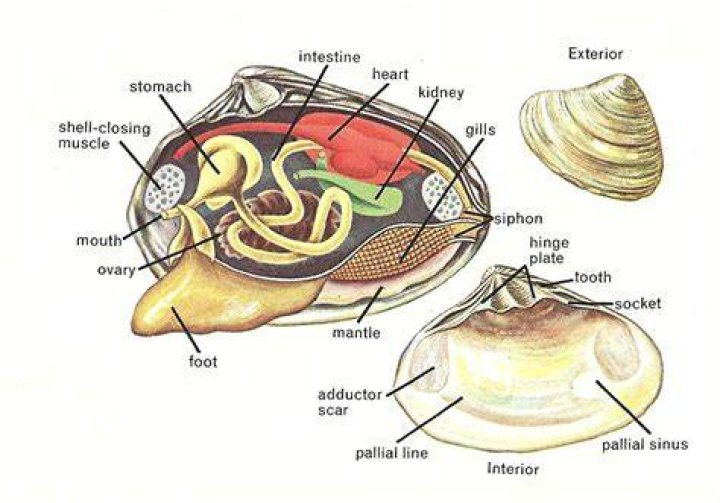
 They manage to maneuver their way beneath the seafloor using their foot. Yes, you heard that right, clams have feet! One foot to be exact. They open their shell enough to stick their foot out and shuffle their way into the sand where they hide from predators.
Can you eat the foot of a clam?
Dip the clam into melted butter and eat! Note, the siphon end of the clam may be a bit tough and rubbery. You can eat it or not. In any case, it makes a great handle for dipping.
What is the function of the clam foot?
The clam’s foot is used to dig down into the sand, and a pair of long incurrent and excurrent siphons that extrude from the clam’s mantle out the side of the shell reach up to the water above (only the exit points for the siphons are shown).
How do you tell the sides of a clam?
The left valve is on topif your clam is correctly positioned. The siphons are at the posterior end. If the siphons are not visible, determine which is the ventral side by using the umbo.
What is a clam foot called?
The bivalve foot, unlike that of gastropods, does not have a flat creeping sole but is bladelike (laterally compressed) and pointed for digging. The muscles mainly responsible for movement of the foot are the anterior and posterior pedal retractors.
What part of the clam should you not eat?
Slip the outer skin off clam’s the neck using your fingers. Set the membrane aside; you will not eat it. Eat the clam using your fingers. Dip the delicious clam into either melted butter, clam broth, or both.
Which clams have pearls?
While all mollusks, including oysters, mussels, and clams can technically make pearls, only some saltwater clams and freshwater mussels are used to commercially grow cultured gem-grade pearls.
Do you eat clam poop?
Pretty much yes you will be ingesting some “poop”. Your eating the whole oysters flesh, reproductive and waste organs which will have some imfesireable fluids and small waste particles.
What is the black part in a clam?
It is the plankton (and other microscopic creatures) eaten by the muscle that are still in its digestive tract when caught and cooked – ie. the undigested remnants the mussel did not have time to digest.
How can you tell a little neck clam?
Native Littleneck Clam Size and Shape: Up to 3.5 inches. Rounded (similar to Manila Clams but more round). Shell: Concentric rings with radiating ridge lines. Siphon tips are fused.
Article first time published on
Do clams have brains?
Clams don’t have a centralized brain like mammals. However, they do have a nervous system, giving them the ability to feel things and react.
Where is the ventral side of the clam?
Ventral is the side, or edge opposite the umbo. Locate the posterior, anterior, dorsal, and ventral surfaces of your clam shell. Hold the clam shell with the anterior end up and the hinge facing toward you. Locate the posterior, right valve, and left valve of the clam shell.
What are the little shells that bury themselves?
If you watch the wet sand at the shoreline just as a wave recedes, you’re likely to see wriggling little coquinas (Donax variabilis) hurrying to rebury themselves in the mud. These colorful clams, about the size of a fingernail, have abounded on Southwest Florida beaches for millennia.
How do you get clams to spit out sand?
Place all the clams in a bowl and fill it with cool tap water. We’ve also heard that adding cornmeal or black pepper to the water will encourage the clams to spit out more sand. Let the clams sit for 20 minutes to an hour. During this time, they will spit out the sand from inside their shells.
Do clams have a tongue?
When shown a similarly strange clam vid, marine biologist Miriam Goldstein told The Huffington Post, “Clams don’t have tongues, in fact. … clams live in mud and sand and they use their foot to help them dig.”
Do oysters have feet?
The foot is actually a muscle specialized for its locomotion. This foot can be used like an anchor and the body is dragged along in the course of the movement. The oysters also have this foot in the initial stages of its life when it moves around searching for a safe spot to attach to.
How does a clam bury itself in the sand?
Braced in the sand, the clam thrusts its fleshy foot downward. Then it squeezes water into the bottom of its foot, causing the appendage to balloon. So anchored, the clam contracts. The pocket of sand around the clam “fluidizes,” loosening up and reducing the drag on the clam, so the shell can slide down to the foot.
Do clams walk?
Giant clams, in fact have the ability to ‘walk’ throughout their life. They have two main types of movement (Huang et al. 2007): Rotation movement – a change of clam orientation without the approximate center of the clam being shifted from initial position.
How much is a pearl from a clam worth?
The value of clam pearls can also vary widely according to factors like size, type, surface quality and color, and just like oyster pearls, natural clam pearls are more valuable than cultured ones. On average, the value of a clam pearl ranges from $300 to $1,500 depending on its quality.
Is an oyster a clam?
Oysters and clams are both bivalves, which is to say edible mollusks enclosed in a two-sided shell, and although they have a lot in common, there is plenty that sets these two delicacies apart. Oysters have irregular shells, and clams have smooth shells. …
How many pearls are in a clam?
Saltwater oysters will only produce 1 to 2 pearls per typical nucleation. Akoya oysters can be nucleated with up to 5 beads but the use of only 2 is most common.
What is inside clam bellies?
But the belly actually refers to the whole of the soft-shell clam: a firm scallop of digestive tract plus the smaller, silkier, brain-balls-heart of the thing. This circuit is connected by terrifically strong but tender muscle, and two thin siphons.
Can you eat clams out of the can?
Canned clams (and also canned oysters) should only be heated briefly, just before they are served to be eaten. They’re already cooked. You just drain and wash them (the brine will be salty) and used them as specified by the recipe you’re using them in, or you can it them as is if you wish.
Can clams feel pain?
Yes. Scientists have proved beyond a doubt that fish, lobsters, crabs, and other sea dwellers feel pain. Lobsters’ bodies are covered with chemoreceptors so they are very sensitive to their environments.
Can you eat the whole inside of a clam?
Here’s the truth: When you eat a clam, you eat the whole animal— all the soft tissue. The good parts and the parts you don’t want to think or talk about because those parts gross you out.
What is a mussel foot?
Like most bivalves, mussels have a large organ called a foot. In freshwater mussels, the foot is large, muscular, and generally hatchet-shaped. It is used to pull the animal through the substrate (typically sand, gravel, or silt) in which it lies partially buried.
What part of the clam are clam strips?
-Strip – Clam strips refer to the loose hanging piece under the belly. -Neck (Siphon) The neck is actually the chewy and kinda gross part that protrudes outside of the clam. A whole belly clam refers to the entire clam insides (belly, strip and neck) and that’s what we’re making today.
Are clams born male or female?
Some species are hermaphrodites (which have both female and male reproductive systems). Male clams produce sperm and release it into the water, while females produce eggs that are retained internally. The sperm get drawn into the female bivalve through her siphons, and fertilization occurs.
What is inside oyster poop?
Yes, yes they do. Oysters expel both real poop AND pseudofeces, which are particles of non-food things in their food.
Why is clam chowder gritty?
If it’s gritty, it has to be sand left over in the clams. The clams need to be soaked in salt water for a while before cooking them. Use about 1 tbsp salt per liter of water and soak for at least an hour (3 is better). This will give the clams time to purge their grit.
What is the difference between top neck and little neck clams?
Little Neck: The smallest size of clam, amounting to 7-10 clams per pound. … Top Neck: These are sometimes also labeled as count neck clams, and they equal roughly 4 clams per pound. Quahog: These big guys are also called chowder clams and weigh in at a mighty 2-3 clams per pound.